Diese Seite wurde noch nicht übersetzt. Sie sehen die englische Originalversion.
SQD for energy estimation of a chemistry Hamiltonian
In this lesson, we will apply SQD to estimate the ground state energy of a molecule.
In particular, we will discuss the following topics using the -step Qiskit pattern approach:
- Step 1: Map problem to quantum circuits and operators
- Setup the molecular Hamiltonian for .
- Explain the chemistry-inspired and hardware-friendly local unitary cluster Jastrow (LUCJ) [1]
- Step 2: Optimize for target hardware
- Optimize gate counts and layout of the ansatz for hardware execution
- Step 3: Execute on target hardware
- Run the optimized circuit on a real QPU to generate samples of the subspace.
- Step 4: Post-process results
- Introduce the self-consistent configuration recovery loop [2]
- Post-process the full set of bitstring samples, using prior knowledge of particle number and the average orbital occupancy calculated on the most recent iteration.
- Probabilistically create batches of subsamples from recovered bitstrings.
- Project and diagonalize the molecular Hamiltonian over each sampled subspace.
- Save the minimum ground state energy found across all batches and update the avg orbital occupancy.
- Introduce the self-consistent configuration recovery loop [2]
We will use several software packages throughout the lesson.
PySCFto define the molecule and setup the Hamiltonian.ffsimpackage to construct the LUCJ ansatz.Qiskitfor transpiling the ansatz for hardware execution.Qiskit IBM Runtimeto execute the circuit on a QPU and collect samples.Qiskit addon SQDconfiguration recovery and ground state energy estimation using subspace projection and matrix diagonalization.
1. Map problem to quantum circuits and operators
Molecular Hamiltonian
A molecular Hamiltonian takes the generic form:
/ are the fermionic creation/annihilation operators associated to the -th basis set element and the spin . and are the one- and two-body electronic integrals. Using pySCF, we will define the molecule and compute the one- and two-body integrals of the Hamiltonian for basis set 6-31g.
# Added by doQumentation — required packages for this notebook
!pip install -q ffsim matplotlib numpy pyscf qiskit qiskit-addon-sqd qiskit-ibm-runtime
import warnings
import pyscf
import pyscf.cc
import pyscf.mcscf

warnings.filterwarnings("ignore")

# Specify molecule properties
open_shell = False
spin_sq = 0

# Build N2 molecule
mol = pyscf.gto.Mole()
mol.build(
    atom=[["N", (0, 0, 0)], ["N", (1.0, 0, 0)]],  # Two N atoms 1 angstrom apart
    basis="6-31g",
    symmetry="Dooh",
)

# Define active space
n_frozen = 2
active_space = range(n_frozen, mol.nao_nr())

# Get molecular integrals
scf = pyscf.scf.RHF(mol).run()
num_orbitals = len(active_space)
n_electrons = int(sum(scf.mo_occ[active_space]))
num_elec_a = (n_electrons + mol.spin) // 2
num_elec_b = (n_electrons - mol.spin) // 2
cas = pyscf.mcscf.CASCI(scf, num_orbitals, (num_elec_a, num_elec_b))
mo = cas.sort_mo(active_space, base=0)
hcore, nuclear_repulsion_energy = cas.get_h1cas(mo)  # hcore: one-body integrals
eri = pyscf.ao2mo.restore(1, cas.get_h2cas(mo), num_orbitals)  # eri: two-body integrals

# Compute exact energy for comparison
exact_energy = cas.run().e_tot
converged SCF energy = -108.835236570774
CASCI E = -109.046671778080  E(CI) = -32.8155692383188  S^2 = 0.0000000
In this lesson, we will use Jordan-Wigner (JW) transformation to map a fermionic wavefunction to a qubit wavefunction so that it can be prepared using a quantum circuit. The JW transformation maps the Fock space of fermions in M spatial orbitals onto the Hilbert space of 2M qubits, that is, a spatial orbital is split into two spin orbitals, one associated with a spin up () electron and another with spin down (). A spin orbital can be occupied or unoccupied. Usually, when we refer to number of orbitals, we will be using number of spatial orbitals. The number of spin orbitals will be double. In quantum circuits, we will represent each spin orbital with one qubit. Thus, a set of qubits will represent spin-up or -orbitals, and another set will represent spin-down or -orbitals. For example, molecule for 6-31g basis set has spatial orbitals (that is, + = spin orbitals). Thus, we will need a -qubit quantum circuit (we may need extra ancilla qubits as discussed later). The qubits are measured in computational basis to generate bitstrings, which represent electronic configurations or (Slater) determinants. Throughout this lesson, we will use the terms bitstrings, configurations, and determinants interchangeably. The bitstrings tell us electron occupancy in spin orbitals: a in a bit position means the corresponding spin orbital is occupied, while a means the spin orbital is empty. As electronic structure problems are particle preserving, only a fixed number of spin orbitals must be occupied. The molecule has spin-up () and spin-down () electrons. Thus, any bitstring representing the and orbitals must have five each for molecule.
1.1 Quantum circuit for sample generation: The LUCJ ansatz
In this lesson, we will use the local unitary coupled cluster Jastrow (LUCJ) \[1\] ansatz for quantum state preparation and subsequent sampling. First, we will explain different building blocks of the full UCJ ansatz and the approximations made in the local version of it. Next, by using ffsim package, we will construct the LUCJ ansatz and optimize it using Qiskit transpiler for hardware execution.
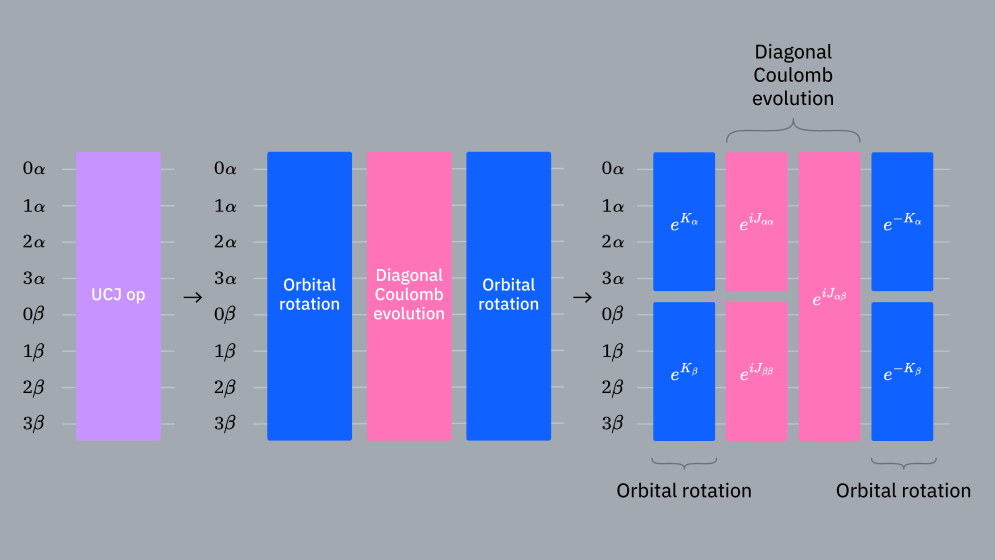
The UCJ ansatz has the following form (for a product of layers or repetitions of the UCJ operator.)
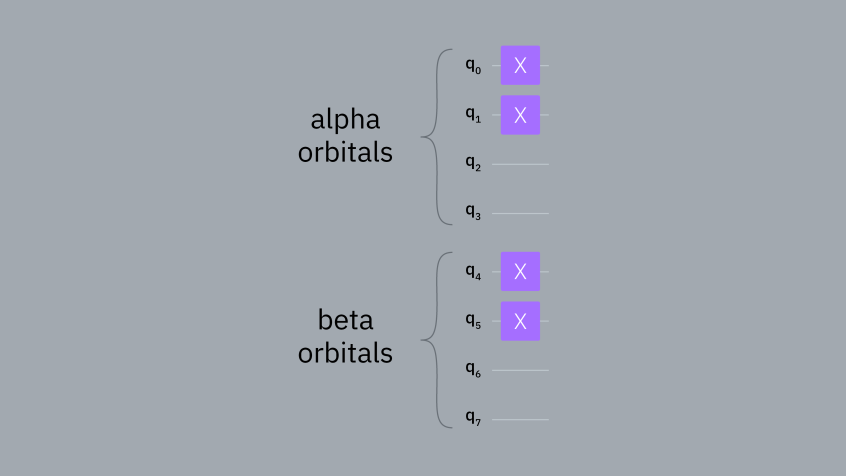
where, is a reference state, typically taken as the Hartree-Fock (HF) state. As the Hartree-Fock state is defined as having the lowest numbered orbitals occupied, the HF state preparation will involve applying X gates to set qubits corresponding to occupied orbitals to one. For example, the HF state preparation block for 4 spatial orbitals and 2 up- and 2 down-spin may look like the following:
 A single repetition of the UCJ operator consists of a diagonal Coulomb evolution () sandwiched by orbital rotations ( and ).
 Orbital rotation blocks work on a single spin species ( (up-spin)/ (down-spin)). For each electron species, orbital rotation consists of a layer of single-qubit gates followed by a sequence of 2-qubit Given's rotation gates ( gates).
The 2-qubit gates act on adjacent spin-orbitals (nearest neighbor qubits), and therefore, are implementable on IBM® QPUs without the need for SWAP gates.
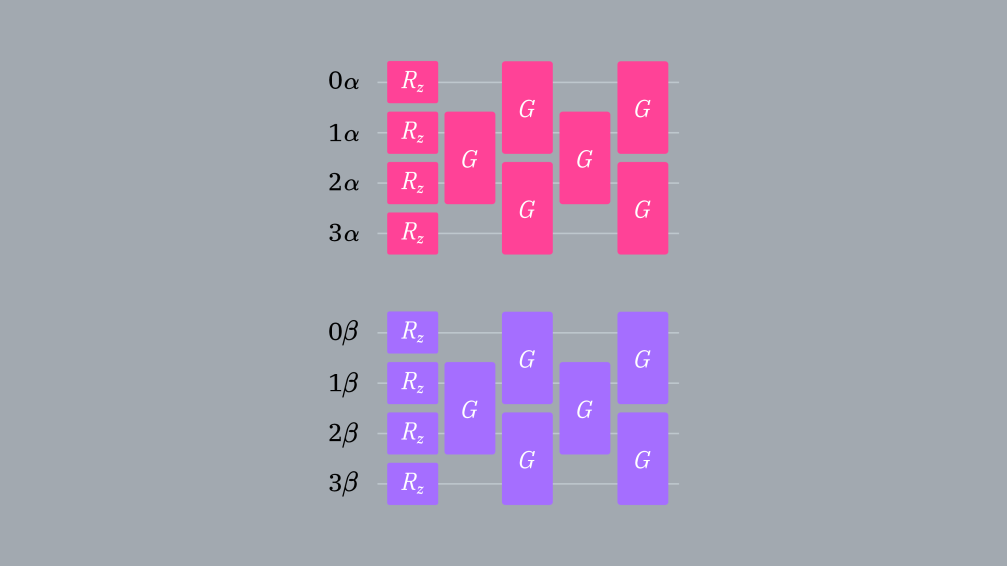 The , also known as the diagonal Coulomb operator, consists of three blocks. Two of them work on same spin sectors ( and ), and one works between two spin sectors ().
All the blocks in consists of number-number gates [1]. A gate can be further broken down into a gate followed by two single-qubit gates acting on two separate qubits.
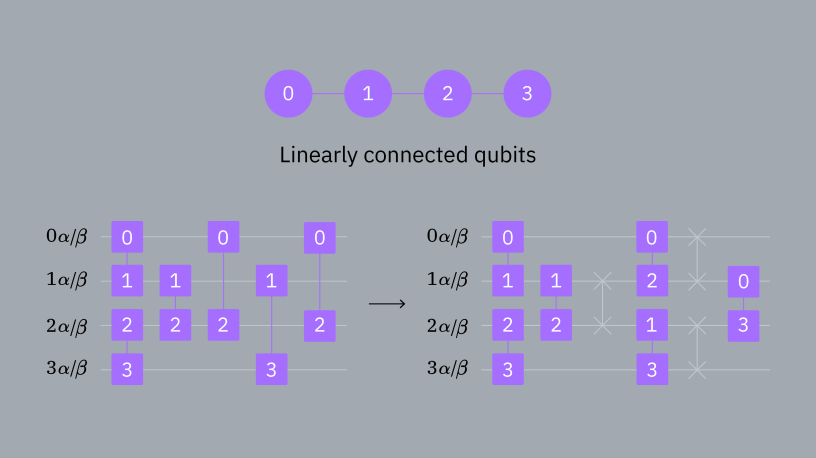
Same-spin components ( and ) have gates between all possible pairs of qubits. However, as superconducting QPUs have restrictive connectivity, qubits must be swapped to realize gates between non-adjacent qubits.
For example, consider the following (or ) block for spatial orbitals. For a linear qubit connectivity, the last three gates are not directly implementable as they work between non-adjacent qubits (for example, Q0 and Q2 are not directly connected). Therefore, we need SWAP gates to make them adjacent (following figure shows an example with SWAP gates).
 Next, the implements gates between same indexed orbitals from different spin sectors (for example, between and ). Similarly, if the qubits are not physically adjacent on a QPU, these gates will also require SWAPs.
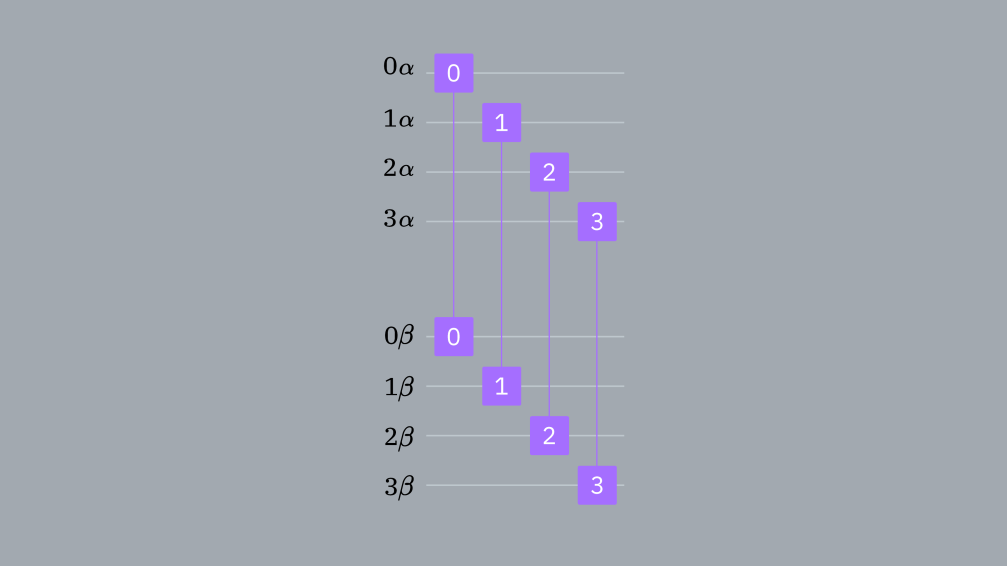 From the above discussion, the UCJ ansatz faces some hurdles for HW execution as it needs SWAP gates due to non-adjacent qubit interactions. The local variant of the UCJ ansatz, LUCJ, addresses this challenge by removing some from the diagonal Coulomb operator.
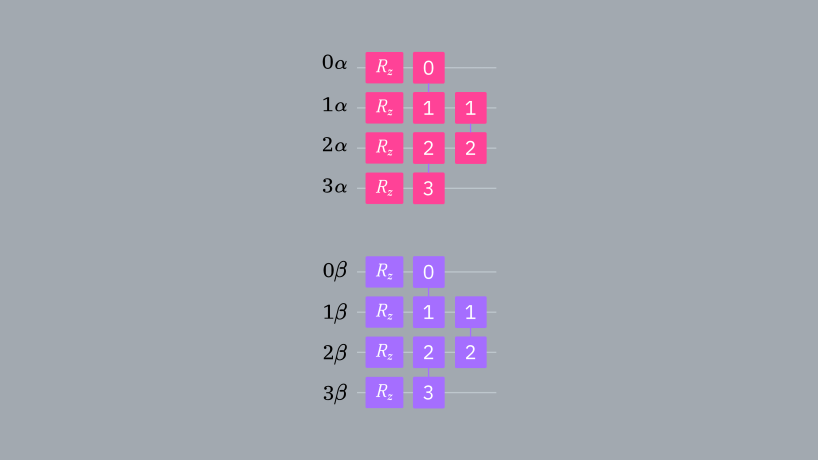
In the same electron species blocks, and ), we only keep the gates compatible with nearest-neighbor connectivity and remove gates between non-adjacent qubits in the LUCJ version. Following figure shows the LUCJ block after removal of non-adjacent gates.
 Next, the LUCJ version of the block that works between different electron species can take different shape based on the device topology.
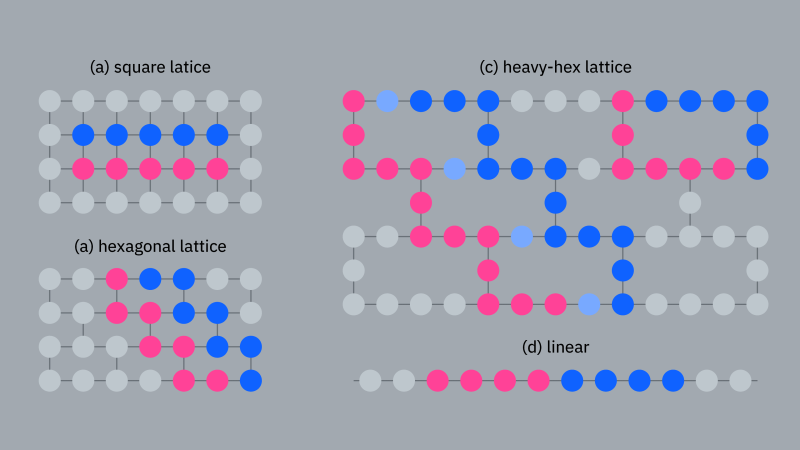
Here, also, the LUCJ version gets rid of non-compatible gates. The figure below shows variants of the block for different qubit topology including grid, hexagonal, heavy-hex, and linear.
- Square: we can have gates between all and orbitals without any SWAPs, and therefore, do not need to remove any gates.
- Heavy-hex: The - interactions are kept between every -th indexed (such as the 0th, 4th, and 8th) spin orbitals and are ancilla mediated, that is, we need ancilla qubits between the linear chains representing and orbitals. This arrangement needs a limited number of SWAPs.
- Hexagonal: Every other orbital, such as 0th, 2nd, and 4th indexed orbitals, becomes nearest neighbors when and are laid out in two adjacent linear chains.
- Linear: Only one and one orbital are connected, which means the block will have only one gate.
 While removing gates from the UCJ ansatz to construct the LUCJ version makes it more HW compatible, the ansatz loses some expressivity. Therefore, more repetitions () of the modified UCJ operator may be needed when using the LUCJ ansatz.
1.2 LUCJ ansatz initialization
The LUCJ is a parameterized ansatz, and we need to initialize the parameters before hardware execution. One way to initialize ansatz is by using t1 and t2 amplitudes from classical coupled cluster singles and doubles (CCSD) method, where t1 amplitudes are the coefficient of single excitation operators and t2 amplitudes are for double excitation operators.
Note that while initializing the LUCJ ansatz with t1 and t2 amplitudes generate decent results, the ansatz parameters may need further optimization.
# Get CCSD t2 amplitudes for initializing the ansatz
ccsd = pyscf.cc.CCSD(
    scf, frozen=[i for i in range(mol.nao_nr()) if i not in active_space]
)
ccsd.run()

t1 = ccsd.t1
t2 = ccsd.t2
E(CCSD) = -109.0398256929733 E_corr = -0.20458912219883
1.3 Constructing the LUCJ ansatz using ffsim
We will use the ffsim package to create and initialize the ansatz with t1 and t2 amplitudes computed above. Since our molecule has a closed-shell Hartree-Fock state, we will use the spin-balanced variant of the UCJ ansatz, UCJOpSpinBalanced.
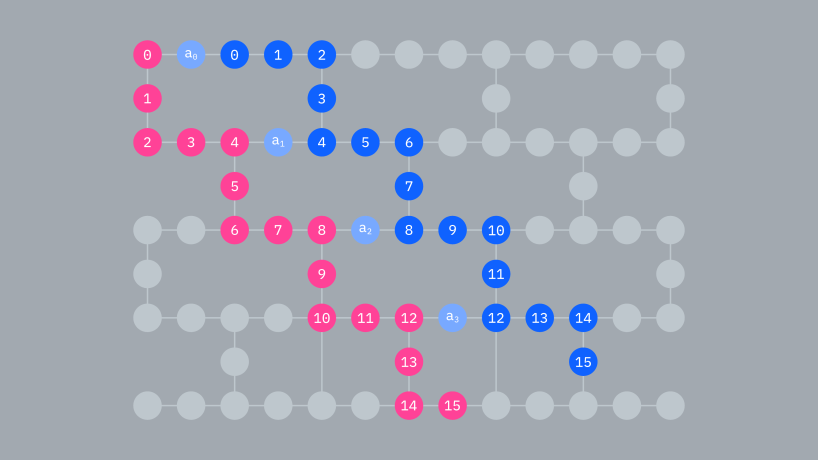
As IBM hardware has a heavy-hex topology, we will adopt the zig-zag pattern used in [1] and explained above for qubit interactions. In this pattern, orbitals (qubits) with the same spin are connected with a line topology (red and blue circles). Due to the heavy-hex topology, orbitals for different spins have connections between every 4th orbital, that is, the 0th, 4th, 8th, and so on (purple circles).
import ffsim
from qiskit import QuantumCircuit, QuantumRegister

n_reps = 2
alpha_alpha_indices = [(p, p + 1) for p in range(num_orbitals - 1)]
alpha_beta_indices = [(p, p) for p in range(0, num_orbitals, 4)]

ucj_op = ffsim.UCJOpSpinBalanced.from_t_amplitudes(
    t2=t2,
    t1=t1,
    n_reps=n_reps,
    interaction_pairs=(alpha_alpha_indices, alpha_beta_indices),
)

nelec = (num_elec_a, num_elec_b)

# create an empty quantum circuit
qubits = QuantumRegister(2 * num_orbitals, name="q")
circuit = QuantumCircuit(qubits)

# prepare Hartree-Fock state as the reference state and append it to the quantum circuit
circuit.append(ffsim.qiskit.PrepareHartreeFockJW(num_orbitals, nelec), qubits)

# apply the UCJ operator to the reference state
circuit.append(ffsim.qiskit.UCJOpSpinBalancedJW(ucj_op), qubits)
circuit.measure_all()
# circuit.decompose().draw("mpl", scale=0.5, fold=-1)
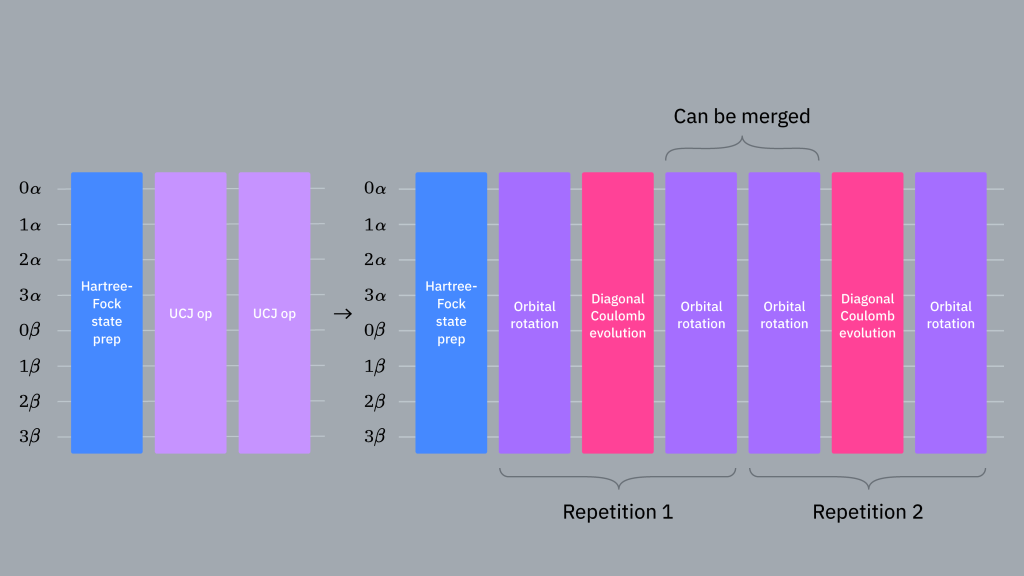
The LUCJ ansatz with repeated layers can be optimized by merging some adjacent blocks. Consider a case for n_reps=2. The two orbital rotation blocks in the middle can be merged into a single orbital rotation block. The ffsim package has a pass manager named ffsim.qiskit.PRE_INIT to optimize the circuit by merging such adjacent blocks.
2. Optimize for target hardware
First, we fetch a backend of our choice. We will optimize our circuit for the backend, and then execute the optimized circuit on the same backend to generate samples for the subspace.
from qiskit_ibm_runtime import QiskitRuntimeService

service = QiskitRuntimeService()
# Use the least-busy backend or specify a quantum computer using the syntax commented out below.
backend = service.least_busy(operational=True, simulator=False)
# backend = service.backend("ibm_brisbane")
Next, we recommend the following steps to optimize the ansatz and make it hardware-compatible.
- Select physical qubits (
initial_layout) from the target hardware that adheres to the zig-zag pattern (two linear chains with ancilla qubit in-between them) described above. Laying out qubits in this pattern leads to an efficient hardware-compatible circuit with less gates. - Generate a staged pass manager using the
generate_preset_pass_managerfunction from Qiskit with your choice ofbackendandinitial_layout. - Set the
pre_initstage of your staged pass manager toffsim.qiskit.PRE_INIT.ffsim.qiskit.PRE_INITincludes Qiskit transpiler passes that decompose gates into orbital rotations and then merges the orbital rotations, resulting in fewer gates in the final circuit. - Run the pass manager on your circuit.
from qiskit.transpiler.preset_passmanagers import generate_preset_pass_manager

spin_a_layout = [0, 14, 18, 19, 20, 33, 39, 40, 41, 53, 60, 61, 62, 72, 81, 82]
spin_b_layout = [2, 3, 4, 15, 22, 23, 24, 34, 43, 44, 45, 54, 64, 65, 66, 73]

initial_layout = spin_a_layout + spin_b_layout

pass_manager = generate_preset_pass_manager(
    optimization_level=3, backend=backend, initial_layout=initial_layout
)

# without PRE_INIT passes
isa_circuit = pass_manager.run(circuit)
print(f"Gate counts (w/o pre-init passes): {isa_circuit.count_ops()}")

# with PRE_INIT passes
# We will use the circuit generated by this pass manager for hardware execution
pass_manager.pre_init = ffsim.qiskit.PRE_INIT
isa_circuit = pass_manager.run(circuit)
print(f"Gate counts (w/ pre-init passes): {isa_circuit.count_ops()}")
Gate counts (w/o pre-init passes): OrderedDict({'rz': 7579, 'sx': 6106, 'ecr': 2316, 'x': 336, 'measure': 32, 'barrier': 1})
Gate counts (w/ pre-init passes): OrderedDict({'rz': 4088, 'sx': 3125, 'ecr': 1262, 'x': 201, 'measure': 32, 'barrier': 1})
3. Execute on target hardware
After optimizing the circuit for hardware execution, we are ready to run it on the target hardware and collect samples for ground state energy estimation. As we only have one circuit, we will use Qiskit Runtime's Job execution mode and execute our circuit.
from qiskit_ibm_runtime import SamplerV2 as Sampler

sampler = Sampler(mode=backend)
sampler.options.dynamical_decoupling.enable = True

job = sampler.run([isa_circuit], shots=10_000)  # Takes approximately 5sec of QPU time
# Run cell after IQX job completion
primitive_result = job.result()
pub_result = primitive_result[0]
counts = pub_result.data.meas.get_counts()
4. Post-process results
The post-processing part of the SQD workflow can be summarized using the following diagram.
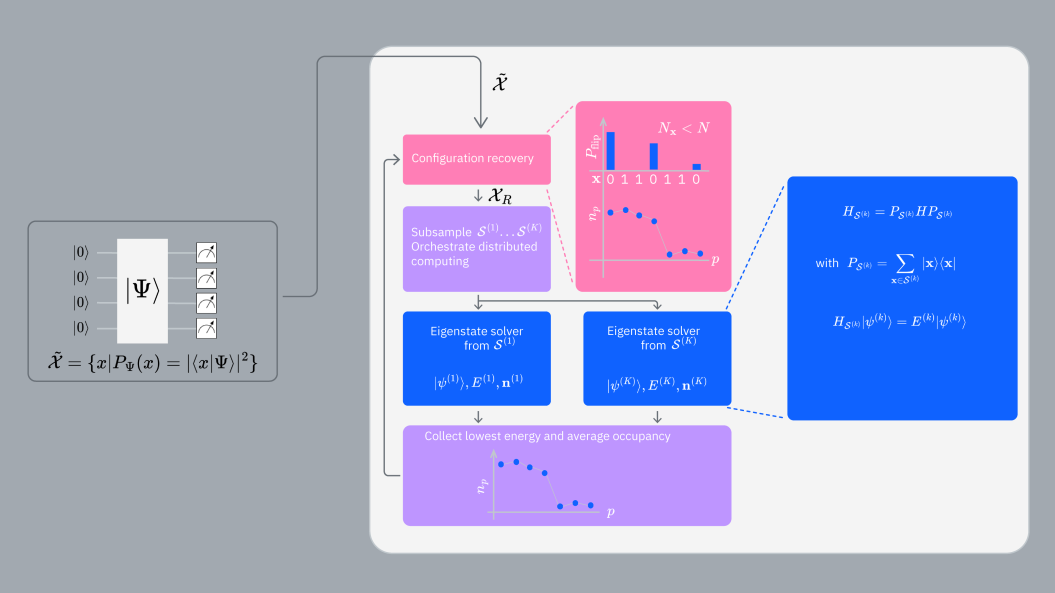 Sampling the LUCJ ansatz in the computational basis generates a pool of noisy configurations , which are used in the post-processing routine. It involves a method called (details discussed later) configuration recovery to probabilistically correct configurations with incorrect electron numbers. Configurations only with correct electron numbers are then subsampled and distributed into multiple batches based on the frequency of appearance of each unique configuration. Each batch of samples defines a subspace (). Next, the molecular Hamiltonian, , is projected onto subspaces:
Each projected Hamiltonian is then fed into an Eigensolver, where it is diagonalized to compute eigenvalues and eigenvectors to reconstruct an eigenstate. In this lesson, we project and diagonalize the Hamiltonian using the qiskit-addon-sqd package which uses the Davidson's method from PySCF for diagonalization.
We then collect the lowest eigenvalue (energy) from the batches, and also compute average orbital occupancy, . The average occupancy information is used in the configuration recovery step to probabilistically correct noise configurations.
Next, we explain the self-consistent configuration recovery loop in detail and show concrete code examples to implement the above-mentioned steps to estimate the ground state energy of Hamiltonian.
4.1 Configuration recovery: overview
Each bit in a bitstring (Slater determinant) represents a spin orbital. The right half of a bitstring represents spin-up orbitals, and the left half represents spin-down orbitals. A 1 means the orbital is occupied by an electron, and a 0 means the orbital is empty. We know the correct number of particles (both up-spin electron and down-spin electron) a priori. Suppose we have a determinant with electrons (that is, there are numbers of s in the bitstring) in it. The correct number of particles is . If , then we know that the bitstring is corrupted by noise. The self-consistent configuration routine attempts to correct the bitstring by probabilistically flipping bits by leveraging average orbital occupancy information. The average orbital occupancy () tells us how likely an orbital be occupied by an electron. If , we have fewer electrons and need to flip some s to s and vice versa.
The probability of flipping can be for i-th spin orbital. In [2], the authors used a weighted probability of flipping using modified ReLU function.
Here defines the location of "corner" of the ReLU function, and the parameter defines the value of the ReLU function at the corner. For , becomes true ReLU function, and for , it becomes modified ReLU. In the paper, the authors used and number of alpha (or beta) particles/number of alpha (or beta) spin orbitals (filling factor).
The average orbital occupancy () is not known a priori. The first iteration of the ground state estimation starts with configurations with only correct particle numbers in both spin species. After the first iteration, we have an estimate of the ground state, and using the estimate, we can construct the first guess of . This guess of is used to recover configurations, run the next iteration of ground state estimation, and self-consistently refine the guess of . The process repeats until the a stopping criterion is met.
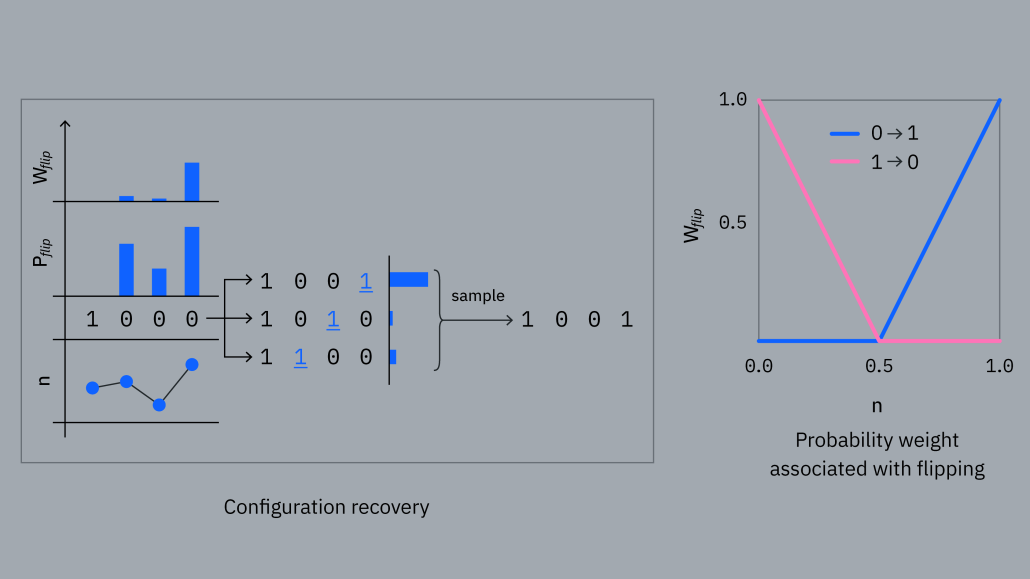
Consider the following example for and (). We need to flip one of the 0s to 1 to correct it for particle numbers, and the choices are 1100, 1010, and 1001. Based on the probability of flipping, one of the choices will be selected as recovered configuration (or the bitstring with correct number of particles).
Suppose in the first iteration we run two batches, and the estimated ground states from them are:
Using the computational basis states and their amplitudes, we can compute probability of electron occupancies (in short occupancies) per spin-orbital (qubit) (note that probability = |amplitude|). Below we tabulate qubit-wise occupancies for each bitstring appearing in the estimated ground state and compute total orbital occupancy for a batch. Note that, as per Qiskit ordering convention, the right most bit represents qubit-0 (Q0), and the left most bit represents Q3.
Occupancy (Batch0):
| Q3 | Q2 | Q1 | Q0 | |
|---|---|---|---|---|
| 1001 | 0.64 | 0.0 | 0.0 | 0.64 |
| 0110 | 0.0 | 0.36 | 0.36 | 0.0 |
| n (Batch0) | 0.64 | 0.36 | 0.36 | 0.64 |
Occupancy (Batch1)
| Q3 | Q2 | Q1 | Q0 | |
|---|---|---|---|---|
| 1001 | 0.33 | 0.00 | 0.00 | 0.33 |
| 0101 | 0.0 | 0.33 | 0.00 | 0.33 |
| 0110 | 0.0 | 0.33 | 0.33 | 0.00 |
| n (Batch1) | 0.33 | 0.66 | 0.33 | 0.66 |
Occupancy (average across batches)
| Q3 | Q2 | Q1 | Q0 | |
|---|---|---|---|---|
| n (Batch0) | 0.64 | 0.36 | 0.36 | 0.64 |
| n (Batch1) | 0.33 | 0.66 | 0.33 | 0.66 |
| n (average) | 0.49 | 0.51 | 0.35 | 0.65 |
Using the average orbital occupancy computed above, we can find the probabilities of flip for different orbitals in the configuration . As the orbital represented by Q3 is already occupied and need not to be flipped, we set its p(flip) to . For the remaining orbitals, which are unoccupied, the probability of flip is each. Along with p(flip), we also compute the probability weight associated with flipping using the modified ReLU function described above.
Probability of flip (, , )
| Q3 | Q2 | Q1 | Q0 | |
|---|---|---|---|---|
| p(flip) () | 0 | 0.51 | 0.35 | 0.65 |
| w(p(flip)) | 0 | 0.03 | 0.007 | 0.31 |
Finally, using weighted probabilities above, we can flip one of the unoccupied Q2, Q1, and Q0 orbitals. Based on the values above, Q0 will be flipped most likely, and a possible recovered configuration can be .
 The complete self-consistent configuration recovery process can be summarized as follows:
First iteration: Suppose the bitstrings (configurations or Slater determinants) generated by the quantum computer form a set , which includes both configurations with correct () and incorrect () number of particles in each spin sector.
- Configurations from () are randomly sampled to create batches of vectors for subspace projection. The number of batches and samples in each batch are user defined parameters. The larger the number of samples in each batch, the larger the subspace dimension and more computationally demanding the diagonalization becomes. On the other hand, too small number of samples may miss the ground state support vectors and lead to incorrect estimation.
- Run the eigenstate solver (that is, projection onto subspace and diagonalization) on the batches and obtain approximate eigenstates. .
- From the approximate eigenstates construct the first guess for .
Subsequent iterations:
- Using correct the configurations with wrong particle number in . Suppose we name them . Then, forms the new set of configurations with correct particle numbers.
- is sampled to create batches .
- Eigenstate solver runs with new batches and generates new estimates of ground states .
- From the approximate eigenstates construct refined guess for .
- If the stopping criterion is not met, go back to step
2.1.
4.2 Ground state estimation
First, we will transform the counts into a bitstring matrix and probability array for post-processing.
Each row in the matrix represents one unique bitstring. Since qubits are indexed from the right of a bitstring in Qiskit, column 0 represents qubit N-1, and column N-1 represents qubit 0, where N is the number of qubits.
The alpha orbitals are represented in the column index range (N, N/2] (right half), and the beta orbitals are represented in the column range (N/2, 0] (left half).
from qiskit_addon_sqd.counts import counts_to_arrays

# Convert counts into bitstring and probability arrays
bitstring_matrix_full, probs_arr_full = counts_to_arrays(counts)
There are a few user-controlled options which are important for this technique:
iterations: Number of self-consistent configuration recovery iterationsn_batches: Number of batches of configurations used by the different calls to the eigenstate solversamples_per_batch: Number of unique configurations to include in each batchmax_davidson_cycles: Maximum number of Davidson cycles run by each eigensolver
import numpy as np
from qiskit_addon_sqd.configuration_recovery import recover_configurations
from qiskit_addon_sqd.fermion import (
    bitstring_matrix_to_ci_strs,
    solve_fermion,
)
from qiskit_addon_sqd.subsampling import postselect_and_subsample

rng = np.random.default_rng(24)
# SQD options
iterations = 5

# Eigenstate solver options
n_batches = 5
samples_per_batch = 500
max_davidson_cycles = 300

# Self-consistent configuration recovery loop
e_hist = np.zeros((iterations, n_batches))  # energy history
s_hist = np.zeros((iterations, n_batches))  # spin history
occupancy_hist = []
avg_occupancy = None
for i in range(iterations):
    print(f"Starting configuration recovery iteration {i}")
    # On the first iteration, we have no orbital occupancy information from the
    # solver, so we begin with the full set of noisy configurations.
    if avg_occupancy is None:
        bs_mat_tmp = bitstring_matrix_full
        probs_arr_tmp = probs_arr_full

    # If we have average orbital occupancy information, we use it to refine
    # the full set of noisy configurations.
    else:
        bs_mat_tmp, probs_arr_tmp = recover_configurations(
            bitstring_matrix_full,
            probs_arr_full,
            avg_occupancy,
            num_elec_a,
            num_elec_b,
            rand_seed=rng,
        )

    # Create batches of subsamples. We postselect here to remove configurations
    # with incorrect hamming weight during iteration 0, since no config recovery was performed.
    batches = postselect_and_subsample(
        bs_mat_tmp,
        probs_arr_tmp,
        hamming_right=num_elec_a,
        hamming_left=num_elec_b,
        samples_per_batch=samples_per_batch,
        num_batches=n_batches,
        rand_seed=rng,
    )

    # Run eigenstate solvers in a loop. This loop should be parallelized for larger problems.
    e_tmp = np.zeros(n_batches)
    s_tmp = np.zeros(n_batches)
    occs_tmp = []
    coeffs = []
    for j in range(n_batches):
        strs_a, strs_b = bitstring_matrix_to_ci_strs(batches[j])
        print(f"  Batch {j} subspace dimension: {len(strs_a) * len(strs_b)}")
        energy_sci, coeffs_sci, avg_occs, spin = solve_fermion(
            batches[j],
            hcore,
            eri,
            open_shell=open_shell,
            spin_sq=spin_sq,
            max_davidson=max_davidson_cycles,
        )
        energy_sci += nuclear_repulsion_energy
        e_tmp[j] = energy_sci
        s_tmp[j] = spin
        occs_tmp.append(avg_occs)
        coeffs.append(coeffs_sci)

    # Combine batch results
    avg_occupancy = tuple(np.mean(occs_tmp, axis=0))

    # Track optimization history
    e_hist[i, :] = e_tmp
    s_hist[i, :] = s_tmp
    occupancy_hist.append(avg_occupancy)
Starting configuration recovery iteration 0
  Batch 0 subspace dimension: 21609
  Batch 1 subspace dimension: 21609
  Batch 2 subspace dimension: 21609
  Batch 3 subspace dimension: 21609
  Batch 4 subspace dimension: 21609
Starting configuration recovery iteration 1
  Batch 0 subspace dimension: 609961
  Batch 1 subspace dimension: 616225
  Batch 2 subspace dimension: 627264
  Batch 3 subspace dimension: 633616
  Batch 4 subspace dimension: 624100
Starting configuration recovery iteration 2
  Batch 0 subspace dimension: 564001
  Batch 1 subspace dimension: 605284
  Batch 2 subspace dimension: 582169
  Batch 3 subspace dimension: 559504
  Batch 4 subspace dimension: 591361
Starting configuration recovery iteration 3
  Batch 0 subspace dimension: 550564
  Batch 1 subspace dimension: 549081
  Batch 2 subspace dimension: 531441
  Batch 3 subspace dimension: 527076
  Batch 4 subspace dimension: 531441
Starting configuration recovery iteration 4
  Batch 0 subspace dimension: 544644
  Batch 1 subspace dimension: 580644
  Batch 2 subspace dimension: 527076
  Batch 3 subspace dimension: 531441
  Batch 4 subspace dimension: 537289
4.3 Discussion of results
The first plot shows that after a few iterations we estimate the ground state energy within ~24 mH (chemical accuracy is typically accepted to be 1 kcal/mol 1.6 mH). The second plot shows the average occupancy of each spatial orbital after the final iteration. We can see that both the spin-up and spin-down electrons occupy the first five orbitals with high probability in our solutions.
Although the estimated ground state energy is decent, it is not within the chemical accuracy limit ( mH). This gap can be attributed to the small subspace dimension we used above for projection and diagonalization. As we used samples_per_batch=500, the subspace is spanned by max vectors, which is missing vectors from ground state support. Increasing the samples_per_batch parameter should improve the accuracy at the expense of more classical compute resources and runtime.
# Data for energies plot
x1 = range(iterations)
min_e = [np.min(e) for e in e_hist]
e_diff = [abs(e - exact_energy) for e in min_e]
yt1 = [1.0, 1e-1, 1e-2, 1e-3, 1e-4, 1e-5]

# Chemical accuracy (+/- 1 milli-Hartree)
chem_accuracy = 0.001

# Data for avg spatial orbital occupancy
y2 = occupancy_hist[-1][0] + occupancy_hist[-1][1]
x2 = range(len(y2))
import matplotlib.pyplot as plt

fig, axs = plt.subplots(1, 2, figsize=(12, 6))

# Plot energies
axs[0].plot(x1, e_diff, label="energy error", marker="o")
axs[0].set_xticks(x1)
axs[0].set_xticklabels(x1)
axs[0].set_yticks(yt1)
axs[0].set_yticklabels(yt1)
axs[0].set_yscale("log")
axs[0].set_ylim(1e-6)
axs[0].axhline(
    y=chem_accuracy, color="#BF5700", linestyle="--", label="chemical accuracy"
)
axs[0].set_title("Approximated Ground State Energy Error vs SQD Iterations")
axs[0].set_xlabel("Iteration Index", fontdict={"fontsize": 12})
axs[0].set_ylabel("Energy Error (Ha)", fontdict={"fontsize": 12})
axs[0].legend()

# Plot orbital occupancy
axs[1].bar(x2, y2, width=0.8)
axs[1].set_xticks(x2)
axs[1].set_xticklabels(x2)
axs[1].set_title("Avg Occupancy per Spatial Orbital")
axs[1].set_xlabel("Orbital Index", fontdict={"fontsize": 12})
axs[1].set_ylabel("Avg Occupancy", fontdict={"fontsize": 12})

print(f"Exact energy: {exact_energy:.5f} Ha")
print(f"SQD energy: {min_e[-1]:.5f} Ha")
print(f"Absolute error: {e_diff[-1]:.5f} Ha")
plt.tight_layout()
plt.show()
Exact energy: -109.04667 Ha
SQD energy: -109.02234 Ha
Absolute error: 0.02434 Ha

Exercise for the reader
Progressively increase the samples_per_batch parameter (for example, from to at a step of ; permitted my your computer's memory) and compare the estimated ground state energies.
References
[1] M. Motta et al., “Bridging physical intuition and hardware efficiency for correlated electronic states: the local unitary cluster Jastrow ansatz for electronic structure” (2023). Chem. Sci., 2023, 14, 11213.
[2] J. Robledo-Moreno et al., "Chemistry Beyond Exact Solutions on a Quantum-Centric Supercomputer" (2024). arXiv:quant-ph/2405.05068.